Policy Insight
Navigating uncertainty in federal funding streams for housing

Overview
City and county governments are primarily responsible for planning and permitting housing and administering programs that meet local housing needs. The federal government supports these efforts through funding for rental assistance programs, grants to state and local agencies, and tax credits for affordable housing development. Yet many of these federal funds for housing are subject to annual appropriation. This means they can fluctuate, especially when a new federal administration takes office. And because federal funds are often braided in a single project or program, changes to even a single funding stream can have wide-ranging impacts.
This uncertainty can make it difficult for localities to set their own budgets and long-term housing goals, plan programs and services, and sustain progress. In the face of this complexity, it is critical for local policymakers and practitioners to have a comprehensive understanding of the federal funding streams flowing into their cities, which are most at risk, and of the projects, programs, and services these funds support.
To support local leaders in understanding how federal funds flow into their jurisdictions, and in partnership with local experts, the Housing Solutions Lab mapped federal funding streams and uses in three cities: Charlottesville, VA; Chattanooga, TN; and Louisville, KY. Below we present highlights from this work, as well as guidance for how cities can conduct their own analysis.
You can also listen to our conversation with Solomon Greene, Executive Director, Land and Communities at the Lincoln Institute of Land Policy; Tony Curtis, Executive Director of the Metropolitan Housing Coalition in Louisville; Sunshine Mathon, Executive Director of the Piedmont Housing Alliance based in Charlottesville; and Hanneke van Deursen, Director of Housing Finance for the City of Chattanooga.
Federal funding streams
Drawing on programmatic documents and public data, the Lab found that major federal funding flows for housing in 2024 could be roughly sorted into three categories: rental assistance, housing development and preservation, and homelessness assistance.
Figure 1. Federal Housing Revenue, 2024 ($in 000s)
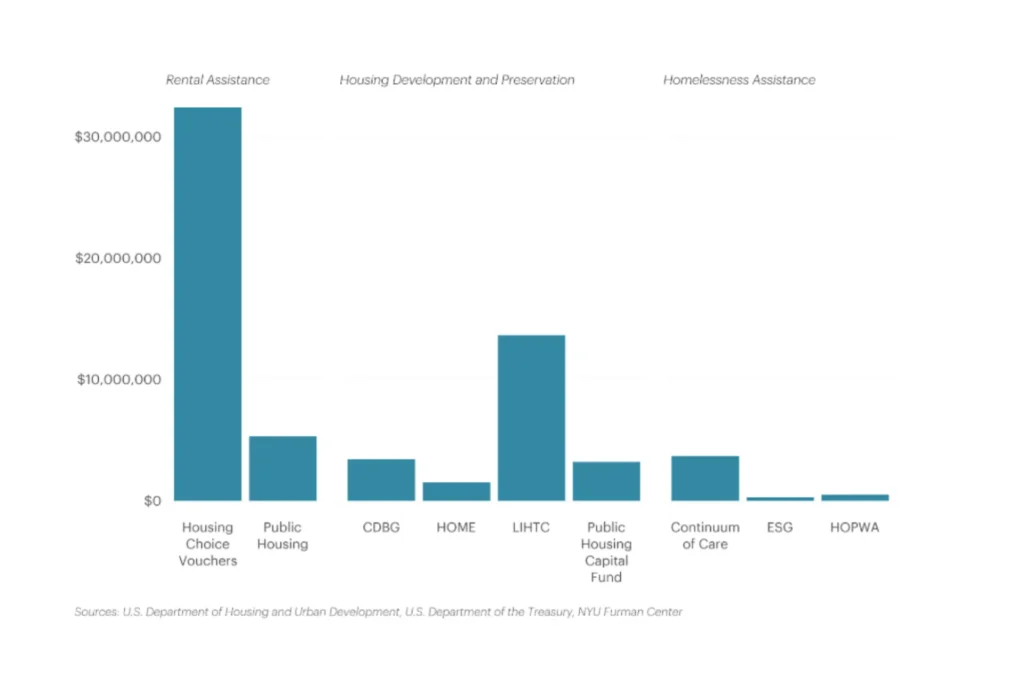
Figure data are available in this spreadsheet
At more than $32 billion of federal investment per year, Housing Choice Vouchers (HCVs) are the single largest funding stream and serve about 2.3 million households across the country. Project-based rental assistance contracts, not depicted above, make up another $15 billion directly paid out to landlords by the U.S. Department of Housing and Urban Development (HUD). The Low-Income Housing Tax Credit (LIHTC) is the flagship federal affordable housing development program. Since 1986, it has helped create 54,000 developments and costs the federal government about $13 billion in foregone tax revenue every year. HUD also awards formula grants, such as the Community Development Block Grant (CDBG) and HOME Investment Partnerships grants, to localities for a wide variety of housing development and rehabilitation activities. Grants to Continuums of Care (CoCs), which are local coalitions of homeless service providers, make up the largest chunk of federal homelessness assistance, at about $4 billion.
Read about these and other federal funding streams for housing in detail here.
Mapping federal funding streams at the local level
By identifying how different funding streams are distributed locally, cities can lay the groundwork for scenario planning or developing strategies that take into account multiple plausible futures. Showing how federal funds support the local housing ecosystem can also help local leaders make the case to state or federal decision-makers to safeguard existing funds or create new ones. When this analysis of federal funding flow is conducted collaboratively, it can help coalesce stakeholders–such as housing authorities, nonprofit developers, service providers, and community foundations, among others. These groups bring different resources and expertise that cities need to plan for and respond to federal shifts.
The Housing Solutions Lab partnered with local stakeholders to map federal funds flowing into three cities: Louisville, Kentucky; Charlottesville, Virginia; and Chattanooga, Tennessee.
Louisville, KY
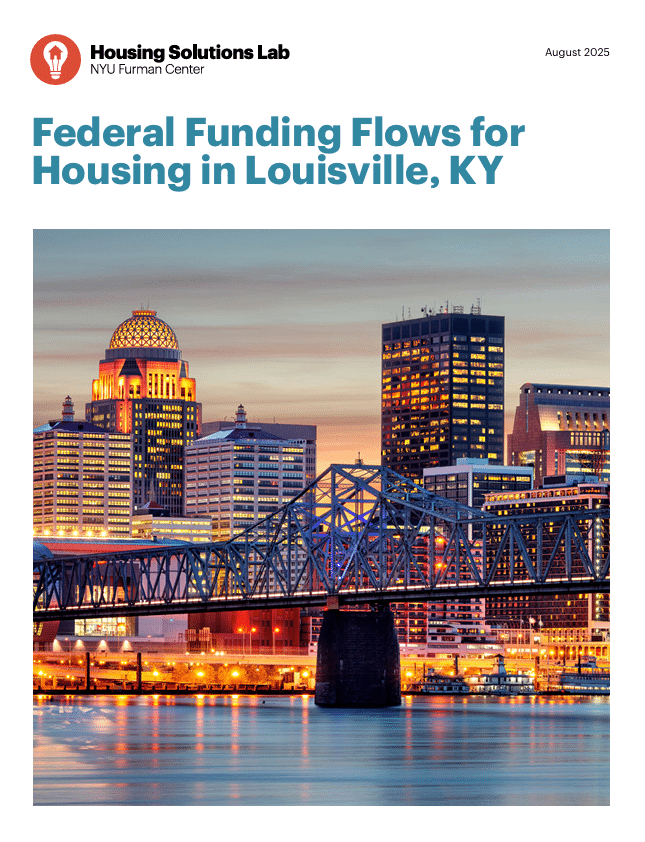
In 2024, Louisville received more than $317 million in federal funds for housing programs from 18 different federal sources. These funds support three main categories of use: rental assistance ($152,148,160), affordable housing development and preservation ($135,909,992), and homelessness prevention and response ($27,816,201). These funds reached approximately 20,500 households.
As the largest of our three case study cities, with a population of more than 640,000, Louisville’s federal housing investment in 2024 was almost double that of Chattanooga (pop. approx. 190,000) and more than triple that of Charlottesville/Albemarle (pop. 160,000). Rental and homelessness assistance are large and critical pieces of Louisville’s federal funding ecosystem.
Charlottesville, VA
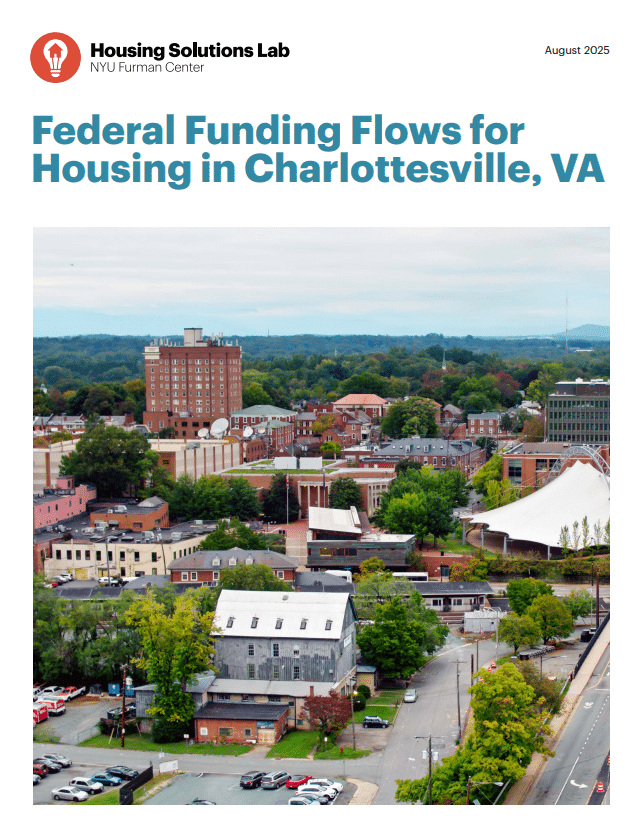
In 2024, Charlottesville and its surrounding county of Albemarle received almost $104 million in federal funds for housing programs from 16 different federal sources. These funds supported affordable housing development and preservation ($88,980,815), rental assistance ($14,466,380), and homelessness prevention and response ($556,828). They reached approximately 3,127 households.
More than 85 percent of Charlottesville’s federal funding for housing went towards developing and preserving over 1,600 housing units in 2024. The share of federal housing funds that Charlottesville dedicates to housing development is at least 17 percentage points greater than that of Chattanooga and Louisville.
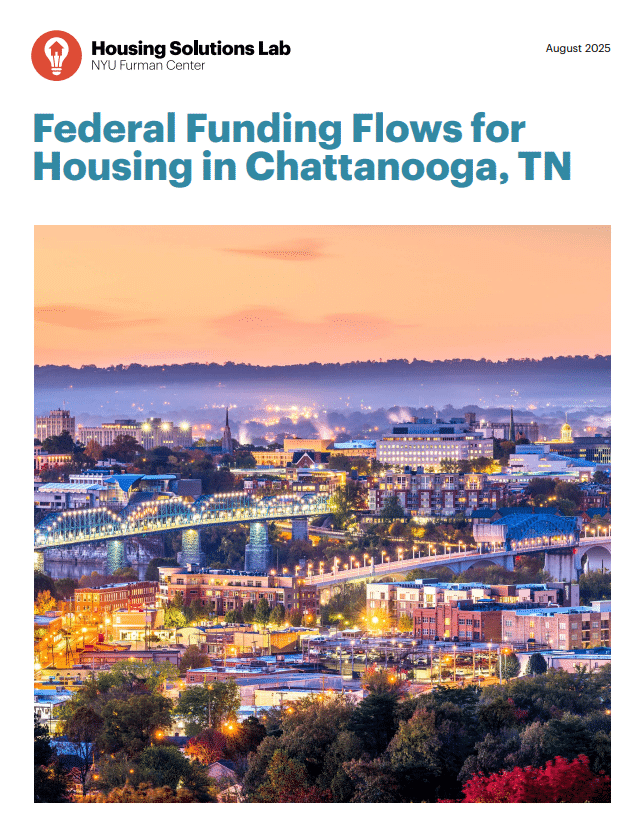
Chattanooga, TN
In 2024, Chattanooga received $174 million in federal funds for housing programs from 14 different federal sources. These funds supported affordable housing development and preservation ($121,111,563), rental assistance ($46,357,624), and homelessness prevention and response ($4,976,316). They reached approximately 7,123 households.
In 2024, Chattanooga received a $50 million Choice Neighborhoods Initiative grant to transform two aging public housing developments and the surrounding Westside neighborhood into vibrant community hubs with new housing and green space.
Guidance for cities
The Lab identified four steps for cities interested in conducting a similar analysis: define the analysis’s purpose and audience, utilize accessible federal data sources like HUD Exchange and USASpending.gov, incorporate local data from action plans and budgets, and interpret findings while accounting for fiscal year variations and funding overlaps. More details about each step are provided below.
Identifying a purpose and audience for the analysis can help inform the shape it takes.
- If the goal is to advocate to federal or state decision-makers to preserve or replace federal funds, it may make the most sense to map federal funds flowing to congressional districts, certain constituencies, or statewide.
- If the goal is to enable scenario planning, a first step might be to consider the players most critical to housing action at the local or regional levels, and to map funds flowing through them, as a way to both understand how they may be affected and to bring them to the table for a proactive local strategy.
- Depending on the audience, cities may also communicate the value of these funds in different ways. Potential approaches include estimating how much local and state spending is leveraged by federal funds, the number of households impacted, or the number of projects and homes supported.
Federal data sources tend to be fairly clean and consistent over time. The geographies for which each dataset is available varies; for example, cities with fewer than 50,000 people usually do not receive a direct award for HUD formula grants, so local data may be needed to tease out the amount of CDBG funding flowing into those jurisdictions from counties and states. In our case studies, we found the most helpful federal resources to be:
- HUD Exchange Awards and Allocations. This website includes federal funding allocations for CDBG, CoC, and other formula grant programs. Information is available for entitlement communities (defined here).
- HUD Community Assessment Reporting Tool (CART). This tool reports granular information about project-based rental assistance contracts and projects, among other data points. Some information is available at the project level.
- HUD’s HCV Data Dashboard. This resource includes specifics for Section 8 HCV and project-based vouchers (PBVs). Information is available at the level of individual public housing authorities.
- USASpending.gov is a comprehensive database of all federal grants, loans, and contracts. While somewhat cumbersome, it can help turn up federal funding sources that localities may otherwise overlook, and it is possible to search at the city, county, congressional district, or ZIP Code level.
The Urban Institute has also developed a tracker to show key federal funding flows and recipients at the state and congressional district levels.
Local sources are key to better understanding how federal dollars are leveraged locally.
- Many jurisdictions must submit Annual Action Plans to HUD detailing how formula grants will be used.
- Other local budget and planning documents, such as housing authority budgets, detail how federal funds are used and how they interact with local and state dollars.
- Press releases, newspaper articles, and local data dashboards can also shed light on specific projects and populations served.
- It can help to organize federal funding flows into three broad categories of housing action: rental assistance, homelessness assistance, and housing development and preservation.
- State, local, and federal agencies may run on different fiscal years and report funding asynchronously, in ways that can’t be reconciled easily. Noting budget timelines associated with different funding amounts, and looking back at funding patterns over several years can help mitigate this issue.
- It may not be possible to avoid identifying people or projects that benefit from multiple funding sources simultaneously. Indicating this when you present your analysis helps avoid providing inflated estimates of people or properties served.
- Finally, local leaders can check their work by comparing local and federal estimates and reach out to colleagues to get a more nuanced understanding of how federal funds support specific programs.
A conversation with local experts
In July 2025, the Housing Solutions Lab, in collaboration with the Lincoln Institute of Land Policy, convened a panel of practitioners from Charlottesville, Chattanooga, and Louisville who shared their insights on the importance of federal funding in their communities, the potential implications of funding shifts, and their efforts to adapt to a rapidly changing landscape. A recording of our webinar, below, presents this conversation alongside key findings from the Lab’s analysis and guidance for cities beginning to plan their own responses.
Additional resources
- In March 2025, HUD announced that funding for Emergency Housing Vouchers would run out by the end of 2026. The Terner Center and Housing Solutions Lab co-authored a brief exploring the implications of the program’s wind-down.
- In June 2025, the NYU Furman Center released Federal Housing Programs in New York City as part of the Center’s annual State of the City report. It takes an in-depth look at the role of federal funds in New York City’s housing ecosystem.
- Yonah Freemark and Amanda Hermans at the Urban Institute released a report detailing how federal funds support housing as well as a catalog of federal housing data sources.
- Urban Institute’s Amanda Hermans and Toni Rajninger conducted a detailed case study of how proposed federal funding cuts would affect housing in the Bay Area.
- Urban Institute has also created a federal housing funding tracker that shows the volume of Housing Choice Voucher, public housing, CDBG, and HOME funds flowing to each state and congressional district. It estimates the number of people and households served.
Acknowledgements
Martha Galvez, Claudia Aiken, Alisa Hartwell, Tony Bodulovic, and Danya Rubenstein-Markiewicz contributed to this analysis. This work was produced in partnership with the Lincoln Institute of Land Policy. The authors would like to thank the following contributors for their expertise and support in shaping this research:
- Solomon Greene, Executive Director, Land and Communities at the Lincoln Institute of Land Policy
- Tony Curtis, Executive Director of the Metropolitan Housing Coalition in Louisville, KY
- Sunshine Mathon, Executive Director of the Piedmont Housing Alliance, based in Charlottesville, VA
- Hanneke van Deursen, Director of Housing Finance for the City of Chattanooga, TN
- Yonah Freemark, Principal Research Associate, Housing and Communities Division, Urban Institute
- Amanda Hermans, Research Associate, Housing and Communities Division, Urban Institute
More Publications
Learn more about what The Lab has to offer.